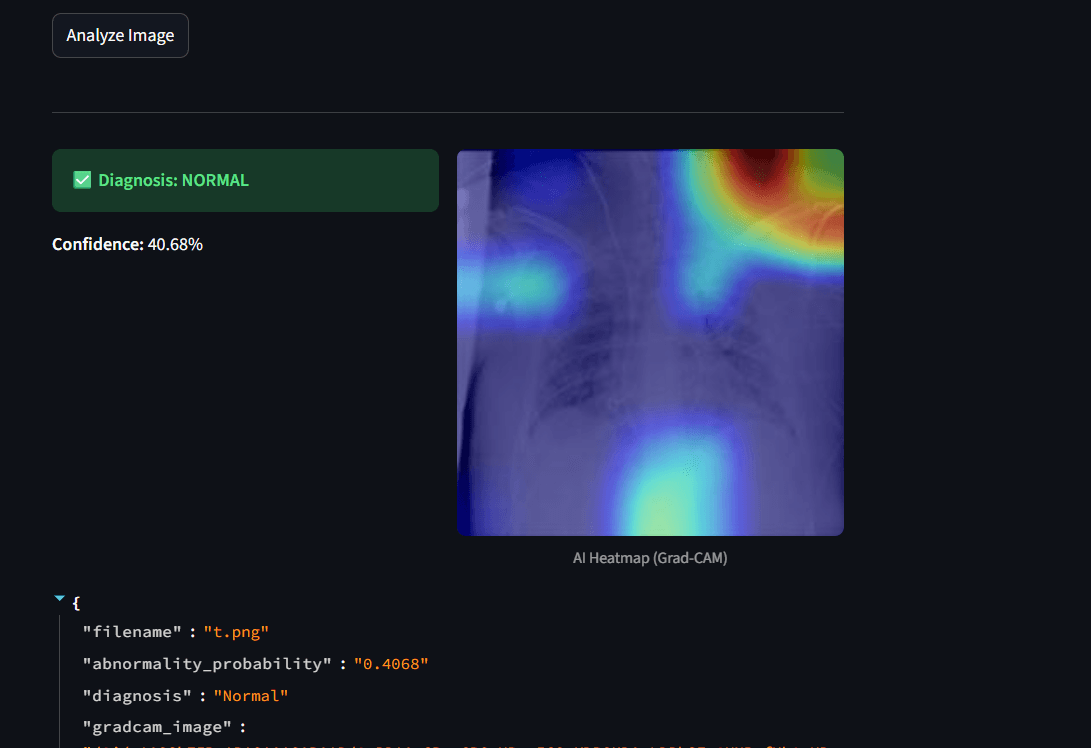
Grad-CAM explainability output
Screenshot from the Chest X-Ray MLOps project showing the model interface with a Grad-CAM visualization used to inspect which image regions influenced the prediction.
Analyze chest X-rays for abnormalities through a deployable medical computer vision workflow.
Local project explainer
A local, predefined assistant for the documented details in Chest X-Ray MLOps System.
Problem
Most medical-CV repos stop at notebook inference. This project turns chest X-ray abnormality detection into a system with a model service, a usable front end, explainability output, and a repeatable deployment path.
Role / contribution
Project author responsible for the inference service, Grad-CAM integration, containerization strategy, frontend/backend separation, and the CI/CD path described in the repository.
Technical implementation
DenseNet121 runs behind a FastAPI service that handles image upload, preprocessing, prediction, and Grad-CAM generation.
A Streamlit interface acts as the user-facing layer so the app can expose predictions and visual explanations without coupling UI concerns to the backend service.
The runtime is containerized with Docker, and GitHub Actions builds and deploys the system through the repository's automated delivery path.
Architecture flow
What happens
A user submits a chest X-ray through the Streamlit interface.
Why it matters
This is the entry point that turns the model into a usable product flow instead of a notebook-only inference script.
Related tools
Engineering decisions
Decoupling the Streamlit UI from the FastAPI service keeps inference and presentation concerns independent.
Grad-CAM is treated as part of the product behavior rather than an optional offline analysis step.
CI/CD and Docker make the repo a deployable system rather than a one-off experiment.
Stack
What I would improve next
Evidence
Screenshot from the Chest X-Ray MLOps project showing the model interface with a Grad-CAM visualization used to inspect which image regions influenced the prediction.