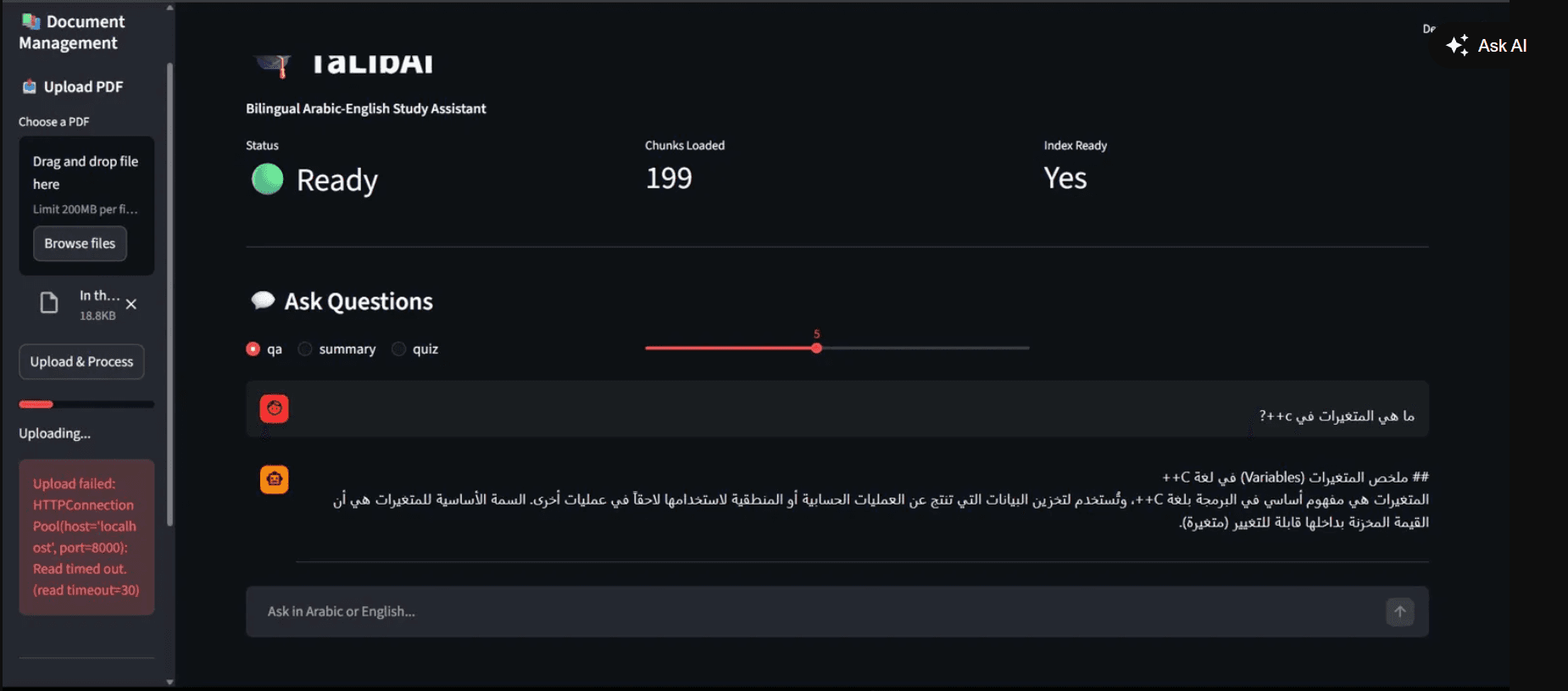
Arabic-first grounded Q&A
TaLibAI answering an Arabic C++ question from indexed course material, with the interface showing the loaded retrieval pipeline and FAISS index state.
Answer Arabic and English study questions from course materials instead of relying on generic model memory.
Local project explainer
A local, predefined assistant for the documented details in TaLibAI.
Problem
Students need answers grounded in their own lecture slides, textbooks, and handwritten notes, but bilingual Arabic-English retrieval is harder when OCR, RTL text, and mixed-language queries are involved.
Role / contribution
Project author responsible for both the manual RAG implementation and the later LangChain refactor, including retrieval design, Arabic normalization, OCR integration, and local-generation path selection.
Technical implementation
The repository includes a manual version built around direct FAISS retrieval, Arabic normalization, custom chunking, and explicit grounding mechanics.
A second version refactors the system with LangChain abstractions, hybrid retrieval, LCEL chains, and local Gemma generation through the documented local-first stack.
OCR support is included for scanned or handwritten notes, which keeps the system useful beyond born-digital PDFs.
Architecture flow
What happens
PDFs, slides, and handwritten notes enter through a loader or OCR path depending on source type.
Why it matters
The assistant only works on real study material if it can handle both clean digital inputs and scanned notes.
Related tools
Engineering decisions
Keeping both a manual pipeline and a framework refactor proves understanding of retrieval internals and higher-level abstractions.
Normalization, RTL handling, and OCR support are system requirements, not cosmetic extras.
The repo's local-generation design keeps the project closer to a practical student assistant than an API-only demo.
Stack
What I would improve next
Evidence
TaLibAI answering an Arabic C++ question from indexed course material, with the interface showing the loaded retrieval pipeline and FAISS index state.
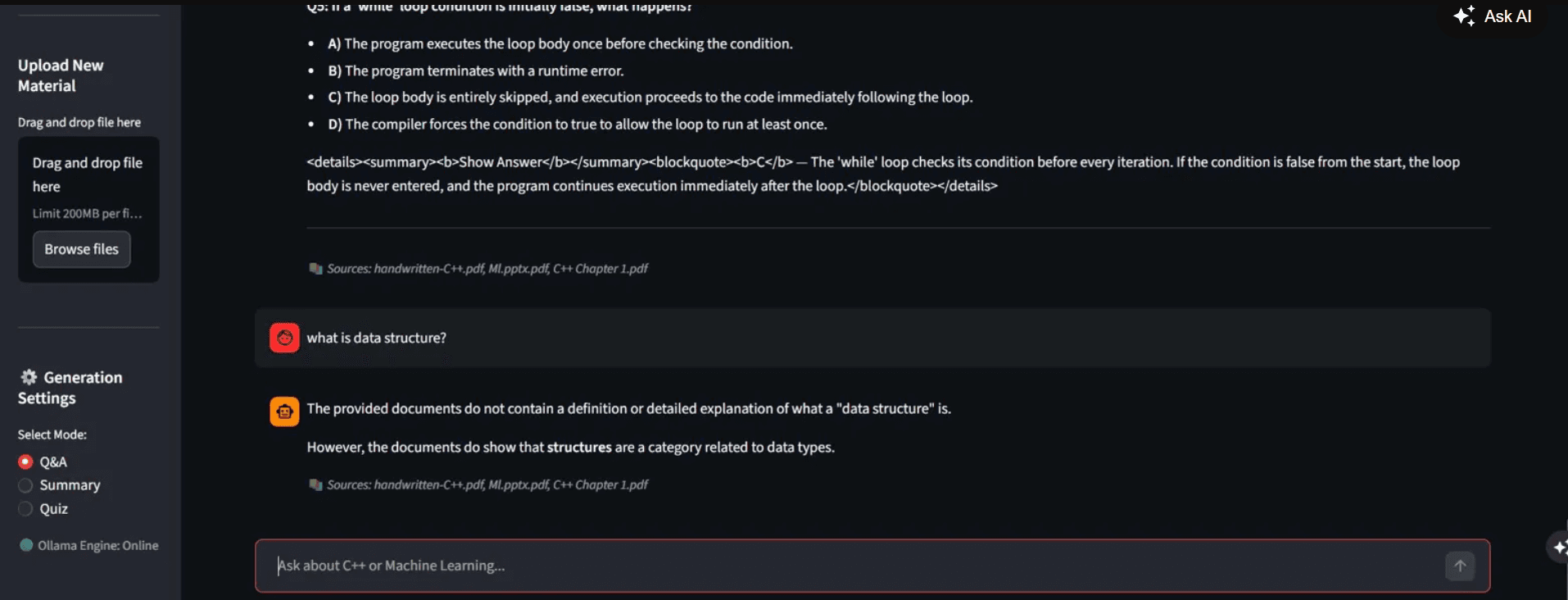
TaLibAI responding conservatively when the indexed documents do not contain enough information to fully answer the question.